
Maryland Death Index
The Maryland Death Index is the official record system used to track deaths that took place in Maryland. Records go back to 1875 for Baltimore City and 1898 for the state's 23 counties. Most searches for recent deaths start with the Maryland Division of Vital Records, while older records are held at the Maryland State Archives in Annapolis. This page helps you find the right office, understand which database covers your date range, and get the death record or certificate you need for any of Maryland's 24 jurisdictions.
Maryland Death Index Overview
Where to Find Maryland Death Index Records
Two main offices handle the Maryland Death Index. The Division of Vital Records is part of the Maryland Department of Health. It manages modern death certificates from 1972 to the present. Their office is at 6764-B Reisterstown Road, Reisterstown Road Plaza, Baltimore, MD 21215. You can reach them at 410-764-3038. As of 2024, visits are by appointment only due to a system transition. The Division charges $10 for the first certified copy and $12 for each extra copy ordered at the same time. For deaths that took place before 1972, the Maryland State Archives in Annapolis holds the records. The Archives is at 350 Rowe Boulevard and can be reached at 410-260-6400. Archives fees run $25 per copy. Both offices have different date ranges, fees, and processes, so it matters which one covers your search.
County health departments also issue death certificates for recent deaths. Most counties handle records from around 2012 to the present, though the cutoff varies by jurisdiction. Some counties, like Garrett County, only keep records from the past 30 days locally. Others, like Anne Arundel County, require an appointment before you visit. Each county has its own fees, hours, and payment rules. Links to each county's page are in the Browse section at the bottom of this page.
The Maryland Department of Health runs an online request portal for death certificates. You can learn about your ordering options and download forms at health.maryland.gov/vsa/Pages/death.aspx.
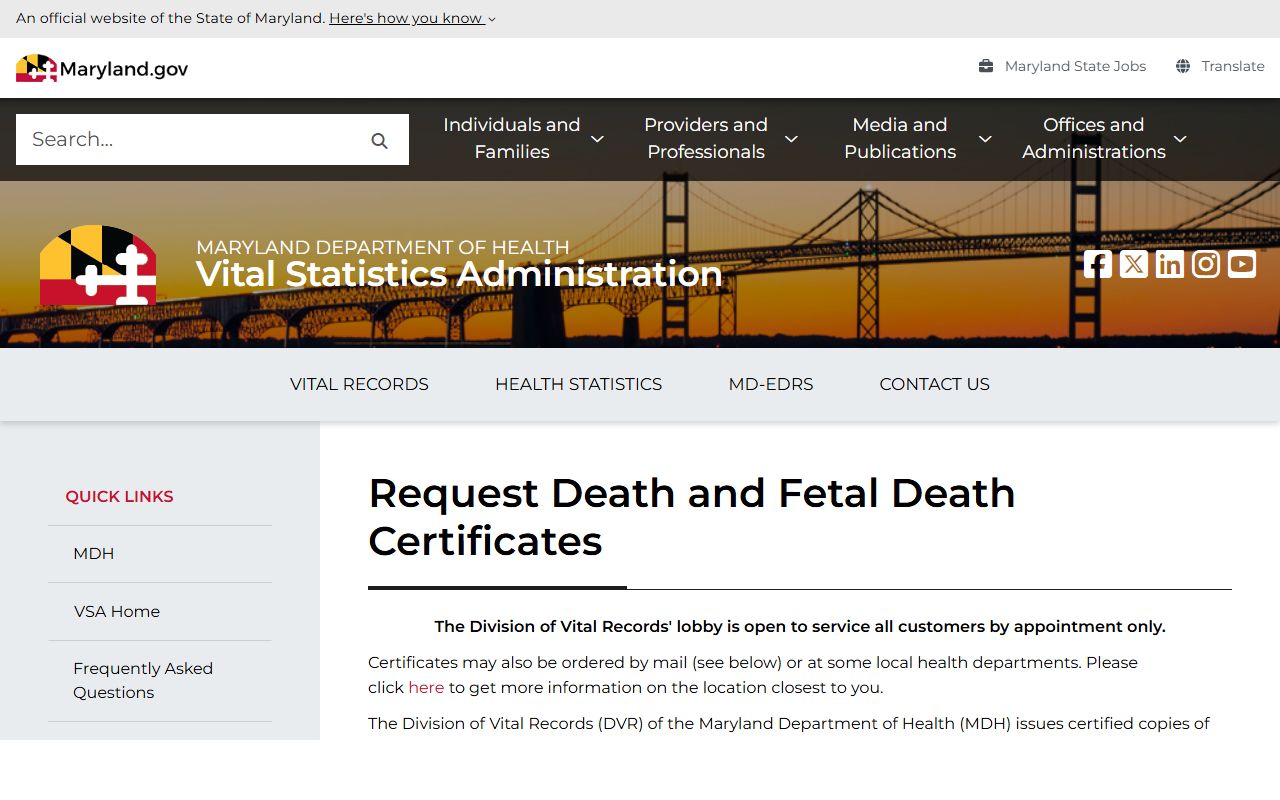
The portal outlines your options for ordering by mail, online through VitalChek, or in person at the Baltimore office.
How the Maryland Death Index Works
The term Maryland Death Index refers to a set of searchable databases held by the Maryland State Archives. The most widely used is the SE151 series. It covers death certificate records from 1973 to 2014 and is searchable by name, date of death, county, age at death, sex, and certificate number. Each county is stored as a numeric code in the database. Code 3 means Baltimore County, while code 30 means Baltimore City. These two are completely separate jurisdictions with separate record systems. Codes 1 through 23 cover Maryland's counties in numerical order. Code 1 is Allegany, code 2 is Anne Arundel, and so on through code 23 for Worcester. If a code above 30 appears in a record, it usually means a Maryland resident died in another state, though no complete key exists for those codes. Special codes 46, 47, and 48 relate to Baltimore City hospital deaths and deaths of Baltimore City residents in Delaware.
The SE151 index was built from pipe-delimited text files transferred by the Division of Vital Records to the Archives. Blank fields simply mean the data was never entered into the original file. A code 9 in the sex or race field means that box was left unchecked on the original certificate. You can search SE151 through the Archives' guide system at guide.msa.maryland.gov/pages/series.aspx?id=SE151. The database does not allow you to search all of Maryland at once. Due to funding limits, each date range has its own separate index. Narrow your search to a 10-year span before searching for faster results. If your location is not in the dropdown menu, the record is likely not in the Archives' holdings.
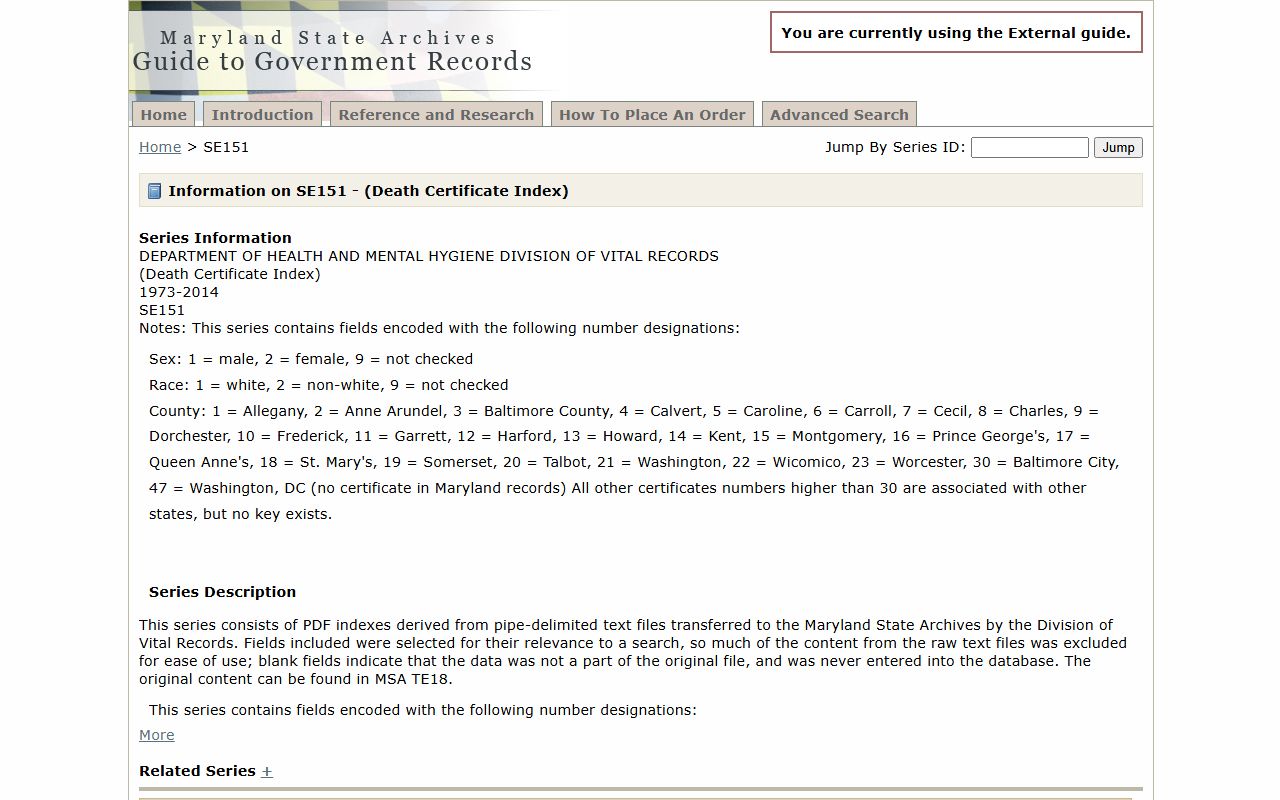
Each SE151 entry includes the decedent's full name, date of death, place of death by county code, age at death, sex, race, and certificate number when available.
Historical Death Record Series at the Archives
Before 1973, Maryland death records are split across several separate series at the State Archives. The earliest statewide county records begin in May 1898, when Maryland law first required counties to keep vital records under Chapter 312 of the Code of Public General Laws. Records from 1898 to 1910 are in series SE42 at the Archives. They are based on 4x6 inch card entries and are available online at guide.msa.maryland.gov/pages/series.aspx?id=SE42. Each card includes the name, cause of death, age, place of birth, parents' names when known, race, occupation, marital status, and spouse's name if any. Very few records exist from before May 1898. Those that do were likely recorded in error as retroactive entries, not actual events from that time.
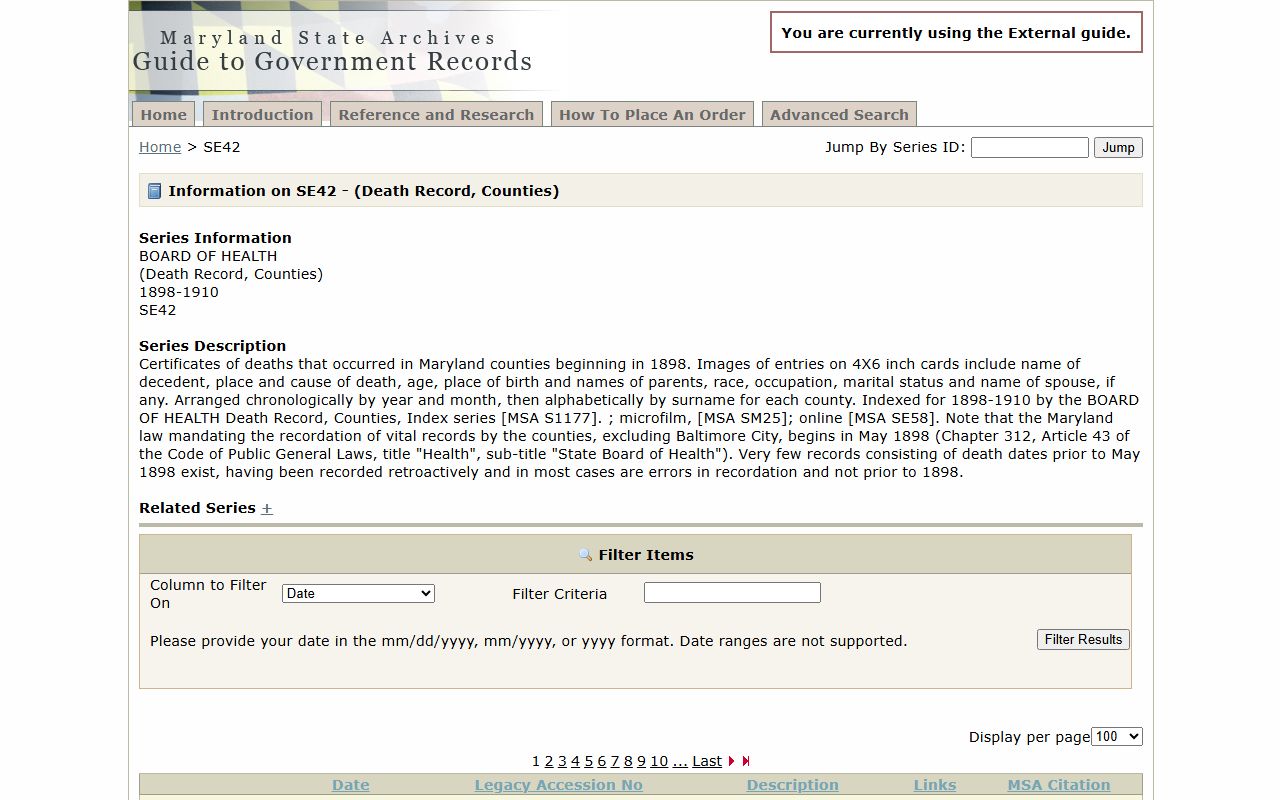
Each 4x6 card entry lists the name, cause of death, age, parents, race, occupation, marital status, and spouse name when applicable.
From 1910 to 1951, the records are in series S1179, which spans 184 microfilm reels organized by year, month, county abbreviation, and surname. These entries are more detailed than later records. Each certificate includes name, sex, race, marital status, age, place of birth, occupation, spouse's name, parents' names, date and place of death, cause of death, burial date and place, and the name of the attending physician and informant. You can access the guide for this series at guide.msa.maryland.gov/pages/series.aspx?id=S1179. For 1951 to 1969, use series S1268, also on microfilm with 106 reels. For 1969 to 1972, use series S1488. Baltimore City death records begin in 1875 under series CM1132, which is 23 years before county records started.
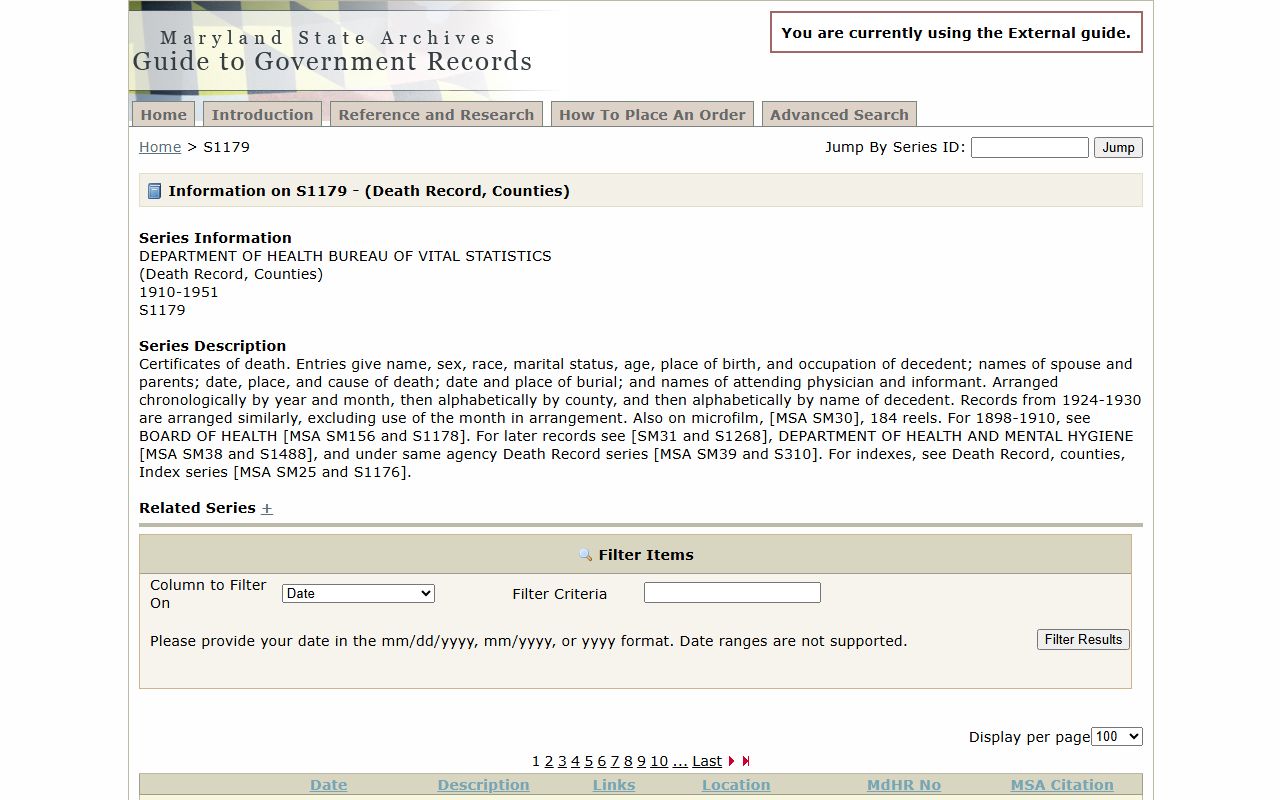
These older records often include parents' names and attending physician details not found in modern death certificates, making them especially useful for genealogy research.
Ordering Maryland Death Records
You can order death certificates from the Maryland Division of Vital Records three ways. Online is the fastest. Use VitalChek at vitalchek.com, the only authorized online vendor for Maryland vital records. The state warns that it cannot guarantee the security or quality of other websites that claim to process Maryland orders. VitalChek handles 4 million vital documents per year, has more than 35 years of experience, and is 100% compliant with PCI payment security standards. Expedited processing is available online, which is not the case for mail orders. The state fee is $10 for the first copy and $12 for each extra one. VitalChek adds its own service fee on top of the state cost. All major credit cards are accepted: American Express, Discover, MasterCard, and Visa.

Always use VitalChek and not other third-party sites when ordering Maryland death records online. The state cannot vouch for any other vendor's security or accuracy.
To order by mail, download the application for a death certificate from the Division of Vital Records website. A bilingual form is available in English and Spanish. Mail the completed form with photocopies of your photo ID, any documentation of your right to access the record, your payment, and a self-addressed stamped envelope to: Division of Vital Records, P.O. Box 68760, Baltimore, MD 21215-0036. Checks or money orders only for mail payments, made out to Division of Vital Records. Expedited shipping is not available for mail orders. For historical records pre-1972, the Maryland State Archives at 350 Rowe Boulevard, Annapolis, MD 21401 accepts mail orders at $25 per copy. Payment there is by check or money order made out to Maryland State Archives.
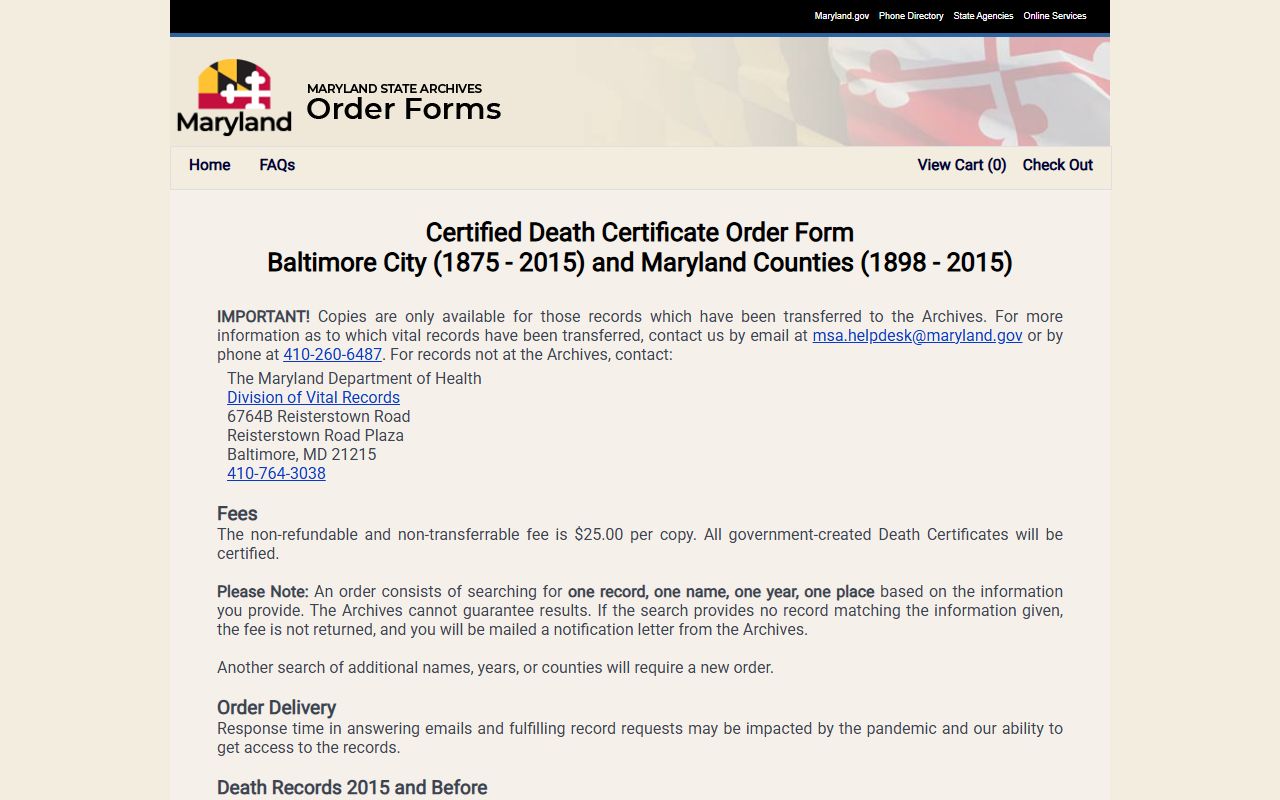
The certificate number is required for Baltimore City deaths before 1973 and all deaths after 1987 when ordering from the Archives, even though the field appears optional on the order form at shop.msa.maryland.gov. Without it, the Archives may not be able to locate the record. A digital copy option is available but is not certified and is for reference only.
Protect Yourself When Ordering Death Records
The Maryland Vital Statistics Administration has issued warnings about scams that target people ordering death records and other vital certificates. One known scam uses phone numbers that closely mimic the real VSA number. Callers pretend to be from the Division of Vital Records and ask for your Social Security number or credit card PIN. The Division will never ask for your SSN or PIN. If you gave this data to a fake caller, contact your credit card company right away. Unauthorized charges from such theft are generally not your responsibility once you report them. The Maryland Attorney General's Identity Theft Unit can help if your identity was used without permission.
Phishing scams also target people seeking death certificates. The state does not upload official records to any outside accounts. All requests must go through official channels with identity verification. Contact the VSA directly at 410-764-3038 or at the email [email protected] if you have any doubt about a request you received.
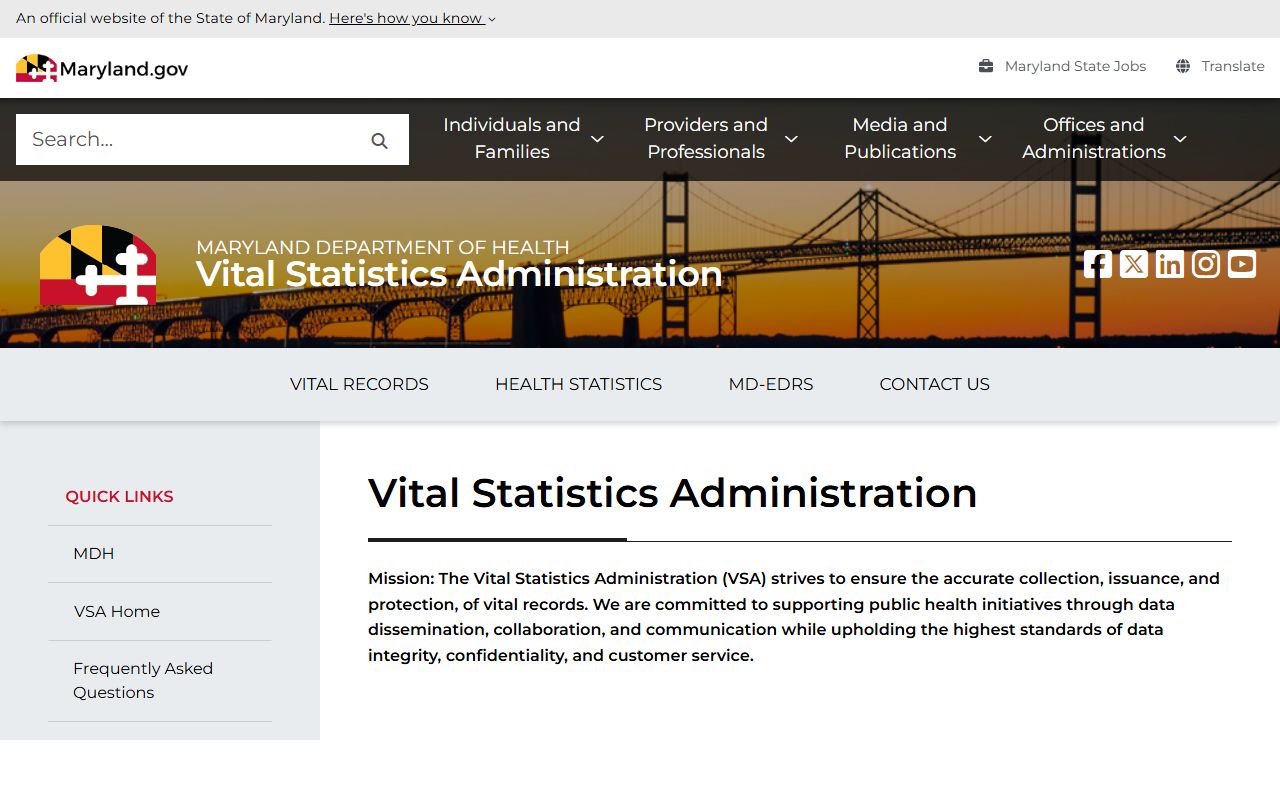
Check the phone number and website before sharing any personal data when ordering Maryland death records. The real VSA website is health.maryland.gov/vsa.
Maryland Death Index Research FAQs
A common question is about the 10-year rule. The State Archives only releases death records for deaths that took place more than 10 years ago. Deaths within the past decade are available only from the Division of Vital Records or county health departments. Another frequent issue is reading the cause of death on older records. Medical terms from past decades can be hard to read or understand. The Archives suggests showing a copy to a doctor to help interpret the cause. Their online glossary of historic causes of death is also a useful resource. The Archives FAQ page at guide.msa.maryland.gov/pages/viewer.aspx?page=death-records-faqs covers the most common research questions.
Parents' names are often missing from Maryland death records. The informant who reported the death may not have known or provided this data. The Archives suggests checking siblings' death certificates or looking at records from a religious institution the person attended. Church burial records often contain family names that state records do not. You cannot search all Maryland death index records at once. Due to funding limits, each date range is a separate index. Narrow your search to a 10-year span before looking through the records for much faster results. Printing at the Archives costs $1 per page, though you can use their free scanner with a flash drive or take photos with your phone.
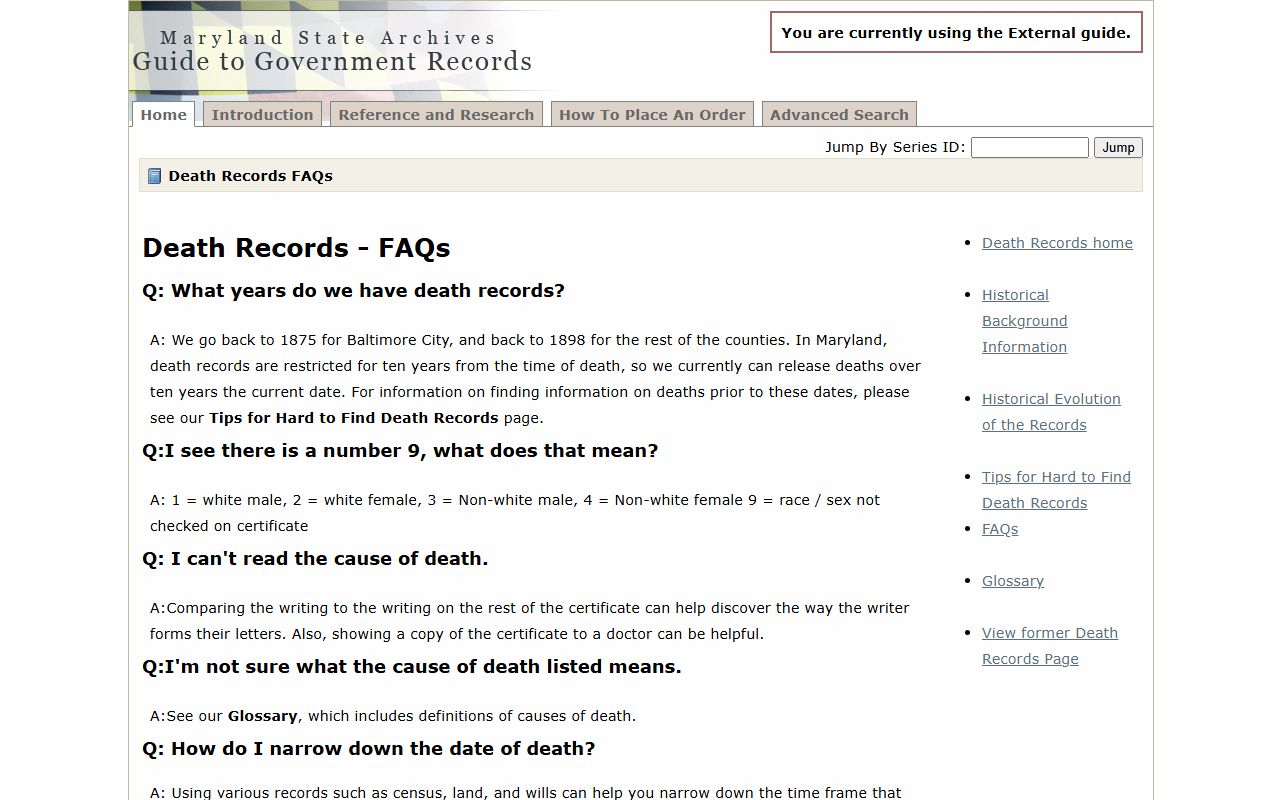
For more complex research questions, contact the Archives staff at 410-260-6400 or at archives@mdsa.net.
Register of Wills and Probate Records
The Maryland Register of Wills is a secondary but often useful source alongside the Death Index. Each of Maryland's 24 jurisdictions has an elected Register of Wills. These offices handle the probate of estates after a person dies. While the Register of Wills does not issue death certificates, it holds estate records that can confirm a death date, show family relationships, and list assets not found in death records. This matters most when vital records are missing or incomplete. The online search portal at registers.maryland.gov/main/ gives free access to estate summary data from 1998 to the present. You can search by decedent name, case number, or filing date. Available details include the estate number and status, date of death, date of filing, personal representative name, attorney name, and full docket history. New rules effective October 1, 2025 updated Maryland Rule 6-209 and Rule 6-311, changing how objections to personal representative appointments are handled. Estates and Trusts Section 8-105 was also amended to include unpaid child support in the order of payment from estates.
In-person access to full probate case files is available at each county's Register of Wills office during normal business hours. Staff can also help with court-related wills and estate questions. More information on wills and estates in Maryland can be found at mdcourts.gov/legalhelp/willsestates.
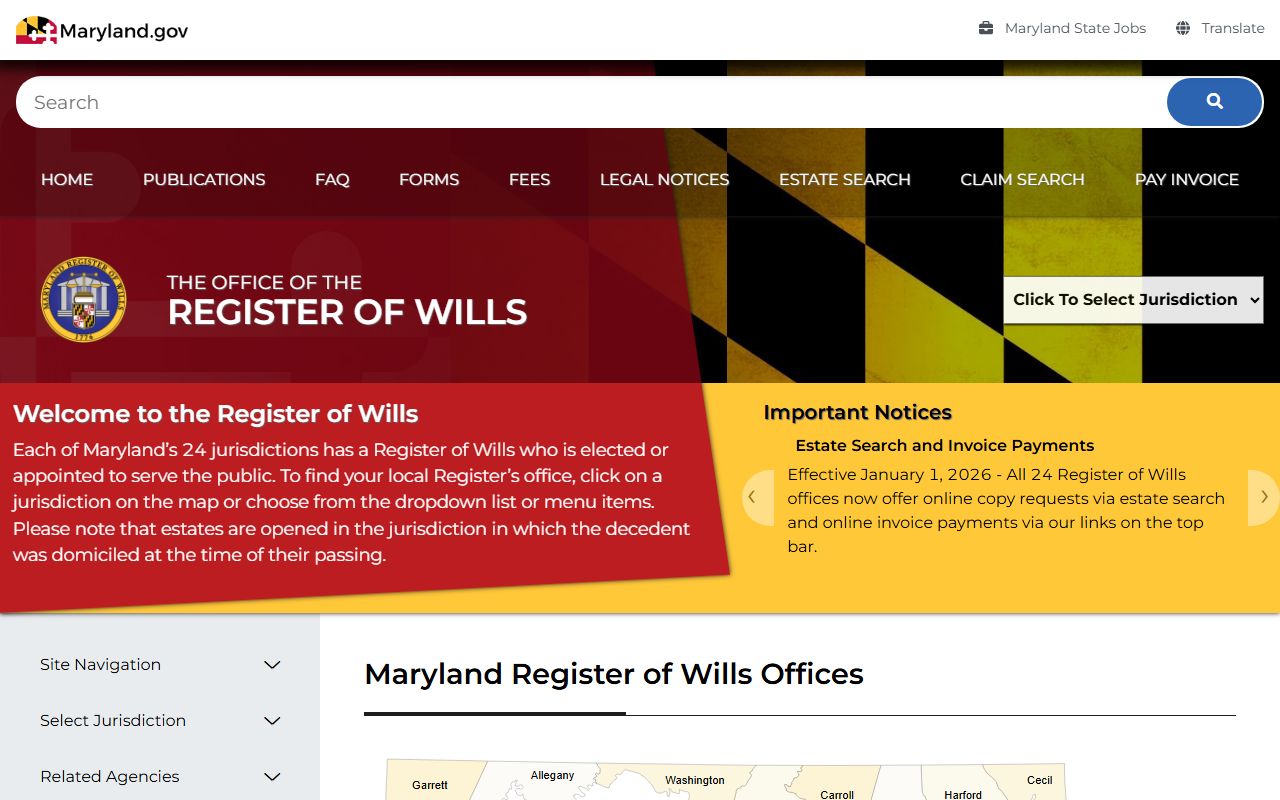
Estate records often fill in research gaps when death certificates are unavailable or when you need details about family members and asset distribution.
Browse the Maryland Death Index by County
Maryland has 23 counties and Baltimore City, each with its own offices and procedures for death records. Pick a county below to find local contact info, fees, and resources for death index searches in that area.
View All 24 Maryland Jurisdictions
Death Index Records in Major Maryland Cities
Residents of major cities in Maryland access death records through their county or city health department. Pick a city below to find out which office handles records for that area.